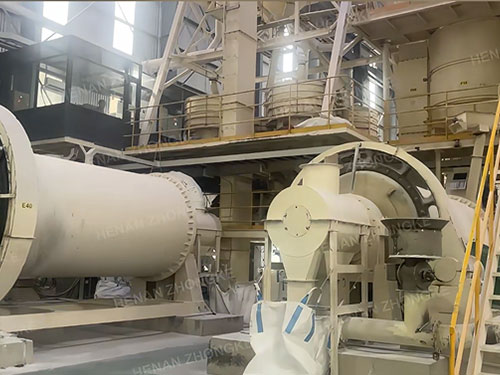
In the world of mineral processing, ceramics, and cement manufacturing, the ball mill is the workhorse of particle size reduction. However, owning a high-capacity mill does not guarantee optimal output. The difference between a profitable grinding operation and a costly bottleneck often comes down to one factor: proper operation.
Operating a ball mill might seem straightforward—load it with steel balls, add material, and let it rotate. But achieving maximum efficiency requires a nuanced understanding of speed ratios, media loading, and material flow. Here is how to fine-tune your ball mill for peak performance.
1. Master the Critical Speed
The rotational speed of the mill is the most critical variable. Every ball mill has a "critical speed"—the point where the centrifugal force pins the grinding media to the inner wall, ceasing the grinding action.
For maximum efficiency, you must operate at 65% to 75% of the critical speed.
Too slow: The balls merely cascade or slide over each other, resulting in low impact energy and inefficient grinding.
Too fast: The balls are thrown against the mill wall without tumbling, leading to excessive liner wear and wasted energy.
To find your optimal speed, calculate the critical speed of your mill diameter and adjust the rotation rate to stay within this "sweet spot" where cataracting (the parabolic trajectory of the balls) is maximized.
2. Optimize the Ball Charge Composition
The grinding media is the engine of the mill. To maximize efficiency, you must maintain the correct ball charge ratio and size distribution.
Volume: The mill should be filled with grinding media to about 30% to 40% of the mill’s total volume. Overfilling reduces the tumbling action; underfilling wastes capacity.
Size Grading: Do not use uniform ball sizes. A mix of large and small balls is essential. Larger balls (e.g., 90mm) are needed to break down coarse feed material, while smaller balls (e.g., 40mm) are required to achieve fine grinding. Regularly check for worn balls and recharge the mill to maintain this balance.
3. Balance the Material Feed Rate
A common mistake in ball mill operation is "overfeeding" or "starving" the mill.
Overfeeding: If you feed material too quickly, the mill will "choke." The material cushions the balls, preventing them from impacting effectively. This leads to a sharp drop in efficiency and potential liner damage.
Starving: If the feed is too low, the balls grind against the liner without sufficient material acting as a buffer, causing excessive liner wear and noise.
The Solution: Use a proportional control system. Maintain a consistent feed rate that matches the mill’s throughput capacity. The ideal load is when the sound of the mill transitions from a loud, metallic clanking (too empty) to a muffled, rolling sound (optimal grinding density).
4. Control the Slurry Density (Pulp Density)
For wet grinding operations, the viscosity of the slurry dictates efficiency. If the slurry is too thick, the balls cannot move freely. If it is too thin, the balls will stick to the liner due to surface tension.
Maintain a pulp density of 70% to 80% solids by weight for most ores. Monitor the viscosity regularly. A well-mixed slurry allows the grinding media to transfer kinetic energy directly to the particles rather than wasting it on fluid friction.
5. Regular Maintenance and Liner Inspection
Efficiency declines rapidly with wear. The mill liners are designed to lift the balls. As liners wear down, the "lift" they provide decreases, effectively altering your operating speed ratio.
Inspect liners weekly. If the lifter bars are worn flat, the grinding action reverts to a less efficient "sliding" mode.
Check for leakage. A loss of slurry around the trunnion bearings indicates seal failure, which leads to material loss and contamination of the lubrication system.
6. Ventilation and Temperature Management
Overheating is the enemy of efficiency. Excessive internal temperatures can cause material agglomeration (clumping) and degrade mill components.
For dry grinding, ensure the air flow through the mill is sufficient to remove fine particles and cool the system.
For wet grinding, monitor the bearing temperatures. High temperatures often signal lubrication failure or misalignment, which forces operators to slow down the mill, sacrificing throughput.
Achieving maximum efficiency in a ball mill is a continuous process of calibration. By maintaining the correct critical speed ratio, optimizing the ball charge, balancing the feed rate, and monitoring slurry density, you can significantly reduce energy consumption per ton of material processed and extend the lifespan of your equipment.
Proper operation isn't just about turning the mill on—it’s about listening to it, measuring its output, and fine-tuning the variables to ensure every kilowatt of power goes into breaking rocks, not wasting energy.